
Energy News
Mar 6, 2026
Fuel distribution system 'collapsed', petrol pump owners warn of closures amid supply strain
The Petrol Pump Owners Association has warned that the country's fuel distribution system has "completely collapsed," citing an unprecedented surge in demand and supply constraints faced by dealers.

Source: REUTERS/Illustration/Catherine Tai


Mar 2, 2026
Hormuz shock puts Bangladesh's energy security at risk
The US-Israel attack on Iran has pushed Bangladesh's energy security to a critical juncture, with policymakers scrambling to assess the risks stemming from Tehran's reported closure of the Strait of Hormuz – a key artery for global oil and gas trade.

Source: The Business Standard
Mar 1, 2026
QatarEnergy stops LNG production after attacks on its facilities; gas prices soar
The state-owned QatarEnergy, formerly known as Qatar Petroleum, announced today (2 March) that it is suspending the production of liquefied natural gas (LNG) and associated products after suffering "military attacks" on its facilities in Ras Laffan Industrial City and Mesaieed Industrial City in Qatar.

Source: The Business Standard
Feb 28, 2026
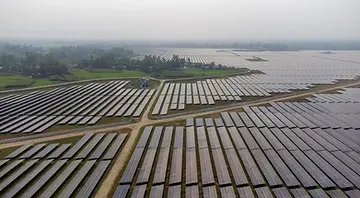
Energy transition sets early test for Bangladesh’s new government
Following the 2026 election, Bangladesh’s new government faces urgent tasks: restoring investor confidence, clearing policy bottlenecks, and accelerating renewable energy projects to put the country’s stalled energy transition back on track
The Business Standard
Feb 24, 2026
Bangladesh’s renewables drive must include women
As Bangladesh slowly advances towards clean and sustainable energy, the transition is not only about cutting carbon emissions. It is also about exploring new avenues for job creation, economic growth, and a fairer and more equal society. And for this to be successful, women must be at the centre of it.

Source: The Daily Star
Feb 22, 2026
Is it possible to keep electricity tariffs stable over the next two years?
Can electricity tariffs be kept at their current level for the next two years? The question has arisen after the newly formed Bangladesh Nationalist Party (BNP) government signalled that it does not wish to increase power prices during that period.
The newly elected government’s Power Minister, Iqbal Hasan Mahmud Tuku, and State Minister Anindya Islam Amit held a meeting on Sunday with senior officials from electricity generation, distribution and transmission companies.

Source: Just Energy News
Feb 21, 2026
Bangladesh’s energy insecurity is a policy failure, not a price problem
Energy insecurity in Bangladesh isn’t just a global problem. Policy design — not world fuel prices — drives high costs, supply risks, and industrial strain
Bangladesh's energy insecurity and high electricity costs are often explained as consequences of global fuel prices, foreign exchange shortages, or capacity payments. While these factors matter, they obscure a more uncomfortable truth: a significant part of our vulnerability is self-inflicted through policy design.

Source: The Business Standard
Feb 21, 2026
Govt plans 100-day energy push
The government is planning a fresh round of bidding for both onshore and offshore gas exploration, with the finalisation of model Production Sharing Contracts (PSCs) targeted within its first 100 days in office.
It aims to complete the bidding process this year and sign final agreements by 2027, officials said.

Source: The Daily Star
Feb 17, 2026
Offshore gas bidding set to launch under new government
Petrobangla is now in a position to launch an offshore bidding round under the newly elected government led by BNP after the Ministry of Law vetted the draft Offshore Model Production Sharing Contract (MPSC) 2026.
This introduces major reforms in gas pricing, pipeline cost recovery and work obligations aimed at attracting international oil companies (IOCs).

Source: Just Energy News
Feb 16, 2026
Businesses hope for revival as new government taking charge
Local independent power producers (IPPs) are owed between Tk13,000 crore and Tk14,000 crore by the government. When joint-venture plants are included, total outstanding dues could exceed Tk25,000 crore, according to the Bangladesh Independent Power Producers’ Association

Source: The Business Standard
Feb 10, 2026
Just Energy Transition: Implications on the Political Landscape of Bangladesh
A roundtable titled “Just Energy Transition: Implications on the Political Landscape of Bangladesh” was held on 20 January 2026, at The Daily Star Centre, Dhaka. Jointly organised by The Daily Star, Coastal Livelihood and Environment Action Network (CLEAN) and other CSOs, the dialogue brought together representatives from notable political parties, CSOs, and NGOs. The Roundtable aimed to deliberate on the 13 Point Citizens’ Demands to political parties ahead of the 13th National Elections regarding the Just Energy Transition.

Source: The Daily Star
Feb 10, 2026
Bangladesh to buy $15b of energy products over 15 years in US trade deal
The deal also includes $3.5b worth of agricultural items, Boeing jets from Washington
Bangladesh will purchase $3.5 billion of US agricultural products and $15 billion of energy products over 15 years, as part of a broader reciprocal trade agreement with Washington signed yesterday.

Source: The Daily Star
Jan 27, 2026
How Bangladesh engineered a power crisis it can no longer afford
BPDB's annual losses have exploded from Tk5,468 crore in FY15 to Tk50,565 crore in FY25, nearly a tenfold increase in a decade.
Bangladesh's power sector has always been ambitious. It wanted to grow fast, build big, and finally silence the old jokes about load-shedding. In one sense, it succeeded: the country now has more installed capacity than it knows what to do with. In another sense, it has created a financial crisis so large that even the most creative accounting cannot hide it.

Source: The Business Standard